ARCTIC microplastic & nanoplastic
A collaboration with the University of Birmingham to study atmospheric micro- & nanoplastics in the Arctic
arctic
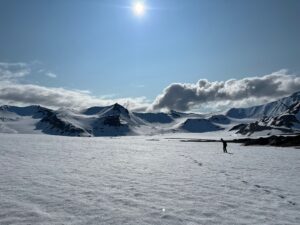
On the archipelago of Svalbard there is an international research base at Ny-Alesund. The Kings Bay base allows us to monitor pollution that enters and is transported around the pristine Arctic environment.
atmospheric map
Micro- and nanoplastics (MNPs) are increasingly being detected in polar and other remote environments. Given their small size (< 5mm) they are readily transported over large distances via air and sea. In addition to long-range transport, local anthropogenic
activities such as tourism and industry also contribute to plastic pollution in the Arctic.
As a pervasive pollutant and bringing added impact through leached chemicals, plastic litter and associated chemicals are of concern to the Arctic Council, in addition to MNPs. The 2020 State of Environmental Science in Svalbard report (SESS report), Section 5, emphasises the evolving nature of microplastic studies, which remain hindered by
significant knowledge gap. AMAP provides recommendations for further development of baseline and trend monitoring.
our approach
Our project represents a pivotal advancement in polar research, through the development of an automated “online” system, removing the need for manual intervention or sampler replacement. This innovation forms a paradigm shift in NMP research, which currently relies heavily on labour/time-intensive sampling protocols. Such a development can allow us to build a true understanding pollution transport and its effects on the Arctic environment. Through this project, we anticipate generating high-impact publications that will serve as benchmarks, providing the feasibility of sustained airborne NMP monitoring in the Arctic.
Full details
Background and Introduction
Nano and Microplastics (NMP) represent a developing global concern, evidenced by their detection not only within human blood (Leslie et al.) but also in remote Arctic environments. Recent literature within the Arctic and microplastics domains underscores the urgent need for expanded research efforts and the development of sophisticated tools to enhance our understanding of microplastic distribution and transport mechanisms (Bergmann et al.) Moreover, the 2020 State of Environmental Science in Svalbard report (SESS report), particularly Section 5, emphasizes the evolving nature of microplastic studies, which remain encumbered by significant knowledge gaps. AMAP, provide similar recommendations, especially for baseline and trend monitoring which are needed to create an understanding on NMP impact in the Arctic.
Polarsense Project
Our project represents a pivotal advancement in polar research, through the development of an automated “online” system, removing the need for manual intervention or sampler replacement. This innovation forms a paradigm shift in NMP research, which currently relies heavily on labour/time-intensive sampling protocols. Such a development can allow us to build a true understanding pollution transport and its effects on the Arctic environment. Through this project, we anticipate generating high-impact publications that will serve as benchmarks, providing the feasibility of sustained airborne NMP monitoring in the Arctic.
Objective 1: Establishment and evaluation of several (3-4) remote monitoring stations, strategically positioned both south and near Ny-Alesund base locations. Later expanding to Longyearbyen.
Objective 2: Continuous assessment and refinement of methodologies over a longer-term duration, including the deployment of a northern station proximal to Kvadehuken.
Objective 3: Collection and subsequent analysis of nanoplastics, microplastics, and associated chemicals, notably polyfluoroalkyl substances (PFAS) over spatial and temporal domains.
Technology
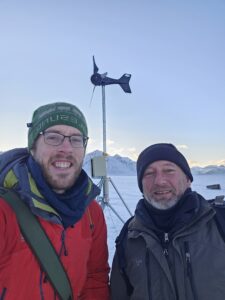
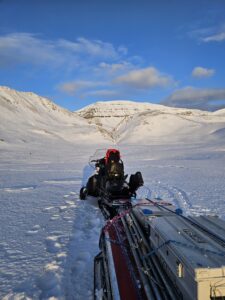
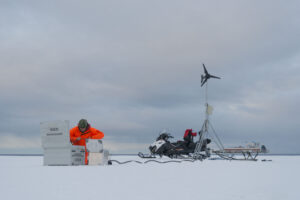
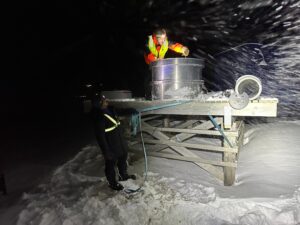
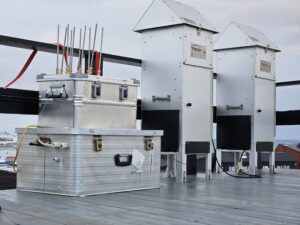
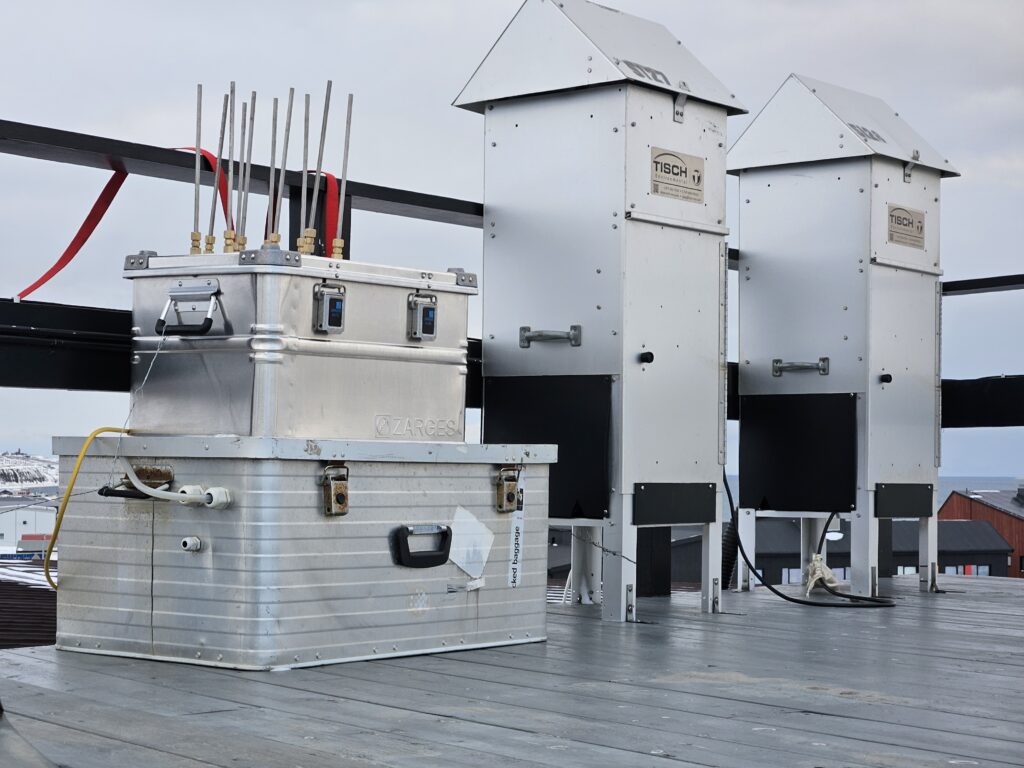
The technology shown in attached webpage images has been developed and deployed, with experience gained from their operation for sampling in the Arctic conditions. The NanoTank, is more frequently used for the study of atmospheric MNPs, traps MNPs in a liquid through a percolation process, overcoming issues such as filter clogging or minimum particle size thresholds. Combined with the autosampler system, which can be deployed for several months, this approach supports AMAP’s goals for harmonised, long-term pollution monitoring.
Who We Are
Roles and responsibilities are distributed across the team, providing complementary
expertise. Dr Kelleher has developed the system and will work on improvements to the
electrical controller and field deployments. Dr Allen, who developed the NanoTanks,
brings expertise in atmospheric MNPs and their modelling, and will lead deployments
and location selection. Dr Materic focuses on nanoplastic analysis, including
atmospheric sampling, and will provide analytical support. Prof Breedveld an
experienced environmental geochemist, will support analytical and field deployments.
Prof Krause, a senior environmental pollution researcher, will provide microplastic
analytical support and data analysis.
Latest News
From 2024-2026 we designed, improved and deployed 2 versions of atmospheric MNP collection samplers across various location on Svalbard. Samples are now being analysed in laboratories at the University of Birmingham.